AI search · Practical guide
How to get cited
by ChatGPT.
Make your page a useful source. Check the answer. Know what to improve next.
The short answer
Give the question
a source worth citing.
To improve your chances of being cited by ChatGPT, publish an accessible page that answers a specific question with accurate, original information. Check search-crawler access, make the source and author clear, then record the actual answer and cited URL.
Start with one page and one useful question. This guide shows the process using a real ChatGPT search about Postomatic, followed by an audit you can apply to your own site.
Key takeaways
- Check the public page. The answer must be accessible without signing in or completing a form.
- Separate search from training. OAI-SearchBot and GPTBot serve different purposes.
- Contribute something you know. Show verified product facts, a worked process or first-hand evidence.
- Save what actually happened. A mention, a citation and a referred visit are different results.
What counts as a ChatGPT citation?
A citation links an answer to a source. In ChatGPT, open the source attached to the relevant passage and inspect the page it points to. Search can produce answers with citations, but you should check the particular response you are evaluating. ChatGPT web search
Your brand is named.
Record the name and the surrounding description. A correct mention helps establish what the response says about the business; it does not prove your page was used as a source.
A source page is linked.
Open the citation. Save its exact URL and the claim it supports. A link to an independent review and a link to your own product page are different sources, even when both mention your brand.
Someone reaches your website.
Check your website analytics for the visit and its next step. The presence of a source link alone does not tell you whether anyone clicked it or started a trial.
For the broader terminology, see SEO vs AEO vs GEO. Here, the task is narrower: inspect one page, run one documented check and choose a useful improvement.
1. Can the search system reach the answer?
Open the published URL as a visitor first. Check that it loads, shows the useful answer and links to the correct page. Then inspect the returned HTML, indexing controls and hosting rules with your developer.
Check these four places
- The page response. Confirm the intended URL returns the page, rather than a login, error or challenge.
- The answer in the HTML. Check whether the important text is available in the initial response. A successful browser render alone does not establish what a crawler received.
- Site and page controls. Inspect robots.txt, page-level robots directives and the canonical URL. Resolve exclusions or conflicting URLs deliberately.
- The hosting layer. Check whether your CDN or firewall blocks the relevant search crawler. Use provider documentation and verified request evidence.
OAI-SearchBot is different from GPTBot
OpenAI identifies OAI-SearchBot as its search crawler and GPTBot as a crawler for content that may be used in training. Their controls are independent. Review the search rules and published IP ranges with your hosting provider. OpenAI crawler documentation
A normal HTTP request, or one that copies a bot’s user-agent, cannot prove a verified OpenAI crawler reached the page. Treat those as access diagnostics. Use verified crawler requests in your own logs when available, and keep the actual citation observation separate.
2. Make the page useful as a source
Choose a question your business can answer with substance. A setup guide can show the real setup. A pricing page can state the actual terms. An About page can identify the product and founder. Each page should make its own answer easy to understand.
Lead with the answer, then demonstrate it
Give the direct response early. Follow it with the conditions, steps, examples or comparisons the reader needs. Put evidence next to the claim it supports. Use a screenshot for a real observation, a table for a decision and a worked example for a method.
Bring verified details from your business: product behaviour, a reproducible test, an explained process or relevant first-hand material. Google’s people-first guidance asks for original value and clear authorship. These are useful editorial checks; they are not a published ChatGPT ranking formula. People-first content guidance
Help the reader identify the source
Use consistent product and company names. Link the article’s real author or editor to an informative profile. Keep structured data aligned with the visible page and connect related pages through relevant internal links.
For example, Postomatic’s homepage introduces the product promise. Its About page answers the founder question explicitly. Those pages serve different reader tasks; repeating a broad marketing headline would not answer both.
Before creating another URL, check whether an existing page already serves the question. Start with the buyer’s question to choose the task. Expand coverage when you have a distinct, useful answer to add.
3. A real check: who founded Postomatic?
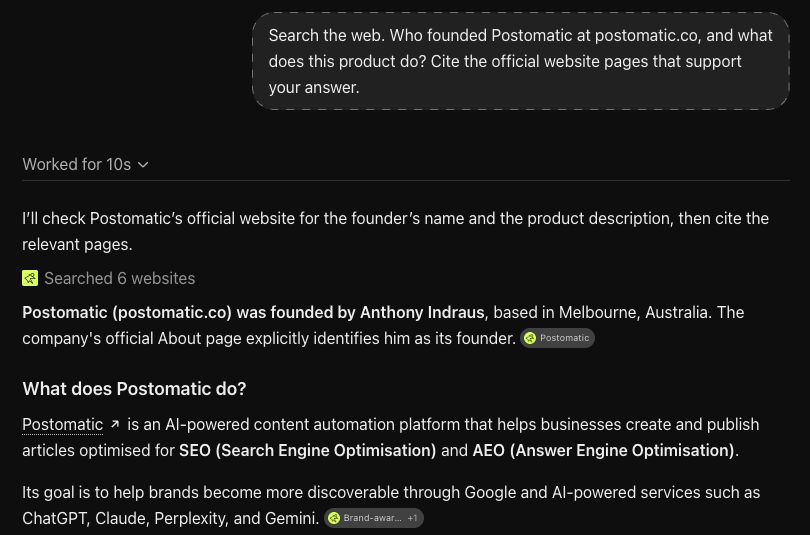
On 30 October 2026, we tested a branded identity question in ChatGPT web. We supplied the domain and asked for official sources. The temporary chat was set to unpersonalized. The exact model version was not exposed in the interface.
Search the web. Who founded Postomatic at postomatic.co, and what does this product do? Cite the official website pages that support your answer.
What the response showed
The activity panel showed “Searched 6 websites”. The answer correctly named Anthony Indraus and described Postomatic’s content workflow. We opened the inline source beside the founder answer: it identified Postomatic’s About page. The response also linked to the official homepage and workflow page.
The cited page’s visible answer: “Postomatic was founded by Anthony Indraus and is built in Melbourne.”
What we could inspect on that page
We separately fetched the public About page and inspected its initial HTML. This ordinary HTTP audit found:
- A 200 response and the canonical URL
https://postomatic.co/about. - The founder answer in the returned HTML, alongside a clear product description.
- Visible identity information and linked Organization and Person structured data that matched it.
- No page-level robots exclusion in that response; robots.txt allowed the site under its wildcard rule.
This establishes one successful branded citation check. It does not show unbranded recommendation frequency, a change caused by a particular edit, verified crawler access or a referred visit. The audit describes the page we could inspect; it cannot tell us why the system selected it.
4. Save an observation you can use again
Keep the same record whether the answer is favourable, missing or wrong. That gives the next check something meaningful to compare.
- Question and context
- The exact prompt, platform, date, available model details and personalization or search settings.
- Search activity
- What the interface showed. Record “not observed” when you cannot confirm search was used.
- Answer and mention
- Save the response or capture. Note whether the brand was named and whether the description was accurate.
- Source citation
- Open the source and record the exact URL, the supported claim and whether the page is yours.
- Next action
- Write the specific page issue, proposed change and date. Keep later observations and website visits separate.
For our example, the record is: branded founder question; ChatGPT web; 30 October 2026; search observed; correct brand and founder; inline citation to /about; no referral measured. It is one observation, so there is no visibility percentage to calculate.
Google’s AI search features are included in Search Console’s Web reporting. That does not make its clicks a ChatGPT citation count. Use what useful SEO progress looks like to keep page discovery, visits and business outcomes distinct. Google’s measurement scope
5. Choose the next edit from the evidence
Fix the issue you can demonstrate. Avoid rewriting a useful page simply because one response did not cite it.
Clarify the business facts.
Check the official product and About pages for inconsistent names, unclear descriptions or outdated facts. Correct the source and record the change before repeating the question.
Improve the relevant page.
Look for a missing direct answer, unsupported claim or absent example. Add the information a real reader would need. If the page cannot substantiate the answer, choose a topic your business can support.
Inspect what that page contributes.
Read the actual source. It may provide an independent review, a clearer explanation or information your page does not contain. Decide whether you can add useful original evidence or correct a factual error.
Inspect the reader’s next step.
The answer may satisfy the question without a click. Check referred visits separately and make the linked page useful for people who arrive. A source citation alone cannot establish a trial or sale.
Return to the saved prompt after the change and retain the full result. For broader discovery, test relevant unbranded buyer questions as their own set. Keep that work distinct from the founder lookup demonstrated here.
Common questions about ChatGPT citations
Can I guarantee that ChatGPT will cite my website?
No. You can check access, improve the answer and observe what happens for a saved question. Those actions do not control source selection. Our worked example records one branded query on one date, rather than promising the same result for a different question or person.
Does a brand mention count as a citation?
A mention means the response names your brand. A citation points to a source page supporting the answer. Open the source and record its URL. A referred visit is a third event, which requires evidence from your own website measurement.
Do I have to allow GPTBot to appear in ChatGPT search?
OpenAI separates GPTBot’s training purpose from OAI-SearchBot’s search purpose. Their controls are independent. Check OAI-SearchBot rules and your hosting access controls for search. A training permission is not a substitute for checking search access.
Does a Google ranking prove that ChatGPT can cite the page?
No. Google performance and a ChatGPT citation are separate observations. Inspect the public page and relevant crawler controls, then record what the actual ChatGPT answer cites. Search Console’s Web report includes Google AI search features; it is not a report of ChatGPT citations.
Should every customer question have its own page?
Create a separate page when the reader needs a distinct answer you can support. Keep closely related questions together when they serve one task. A product setup tutorial and a broad category comparison may need different pages; minor wording variations usually do not.
How often should I repeat a citation check?
Choose a repeatable schedule that fits the decision you are making, and record every run in the same way. Save the question, platform, date, search activity, answer and exact cited URL. Keep favourable and unfavourable observations. If you change the page or test context, record that too.
Go to the source
Primary sources
Platform guidance checked on 30 October 2026. The worked example comes from our saved ChatGPT observation and public-page audit on that date.
- OpenAIOverview of OpenAI Crawlers
Search crawling, training controls and published crawler IP ranges.
- OpenAIWeb search in ChatGPT
Search use and source citations in the ChatGPT experience.
- Google Search CentralCreating helpful, reliable, people-first content
Original value, authorship and evidence of experience.
- Google Search CentralAI features and your website
Google’s AI search guidance and Search Console measurement scope.
Turn your knowledge into better answers.
See how Postomatic connects brand knowledge, customer questions and published content.
Explore the workflow